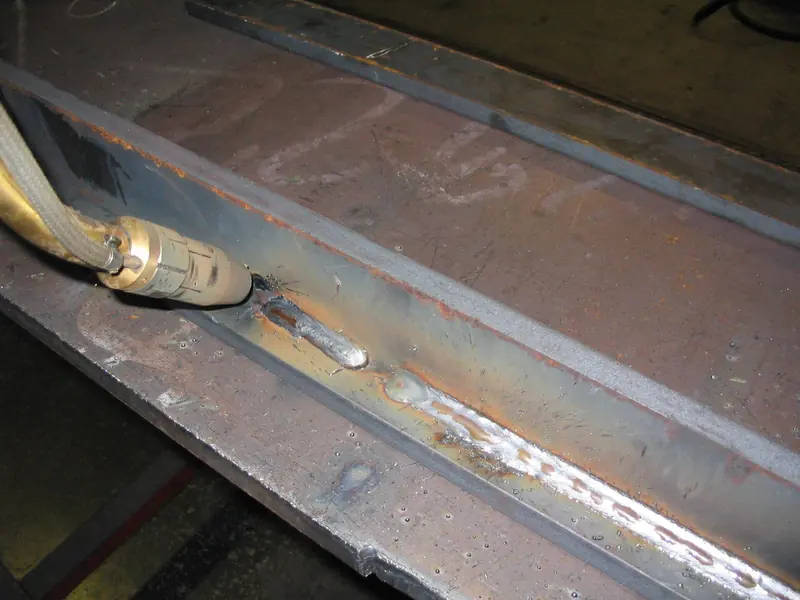
What structural and steel repair means
The term covers a wide range. At the small end it is a cracked bracket on a shop shelf or a loose handrail post on a concrete step. At the larger end it is a damaged support beam, a bent canopy frame, a broken mezzanine connection or a cracked weld on a platform that people walk on.
What these jobs share is that the metal has a load to carry. A weak repair is not just a cosmetic failure. It can drop equipment, a platform or a person. That is why the welder's judgment about what to cut out, how to prepare the joint and whether to add reinforcement matters more here than on a decorative job.
Signs you need it
Steel usually warns you before it fails. Do not wait for a part to separate completely.
- Visible cracks, especially at the edge of an old weld or at a corner.
- Rust that has flaked, bubbled or eaten through the surface.
- Bolts or plates that have loosened, or holes that have stretched into slots.
- A frame, beam or shelf that sags, bounces or has shifted out of square.
- Impact damage from a truck, forklift or trailer.
What affects the cost
Welders set their own hourly rates and call-out charges. National cost guides, which are not Houston-specific, put a typical welding job at roughly $159 to $514 with a minimum charge near $60, and the mobile welding cost guide lists the sources. A small bracket or handrail repair may take under an hour of welding. A beam repair with cutting, fitting and reinforcement plates can take a full day or more. These are rough figures only, and quotes vary by job, material, access and urgency.
The main cost drivers are listed below. Ask the provider which ones apply to your job.
- Thickness and type of steel, since thicker sections need more passes and more preparation.
- How much grinding, cutting and fit-up is needed before welding starts.
- Access: working at height, in a tight space or over live equipment takes longer.
- Materials such as plate, angle, anchors or paint, if they are not included in the rate.
- Rush or after-hours scheduling.
- Whether the work needs a permit, drawings or inspection, which adds time outside the welding itself.
What to expect, step by step
A careful structural repair follows a sequence. If a provider wants to jump straight to striking an arc, ask why.
- Assessment: the welder looks at the damage, asks what the part carries and checks for hidden cracks or rust behind the surface.
- Safety: the load is supported or removed, flammable material is cleared, and a fire watch is planned where needed.
- Preparation: coatings, rust and paint are ground back to clean metal, and cracked or thin sections are cut out.
- Welding: new metal is fitted and welded, sometimes with reinforcement plates added across the repair.
- Finishing: welds are cleaned, inspected by eye and coated or primed to slow new rust.
- Walk-through: you review the work and ask about any limits on how the part should be used.
How to choose a welder
Ask whether the provider has done structural work like yours. Ask how they would fix it before they arrive, and whether they would recommend an engineer to look at it first. A willing answer to that last question is a good sign, not a sales loss.
If the part is part of a building, a public space or something an inspector may review, ask whether the work needs a permit or a specific certification and who is responsible for that. Check with your city or county permit office when in doubt. Do not rely on a verbal promise that it is fine. Get the scope, price and payment terms in writing, even if it is only a text message. The full list of questions to ask a mobile welder covers scope, price, process and paperwork, and the stick, MIG and flux-core guide helps you follow the answers.
What to prepare
Clear the area around the repair and keep people and vehicles away while work is under way. Move anything flammable, such as fuel cans, paper, pallets and dry brush. Make sure the truck can reach the spot, and tell the welder about overhead lines, soft ground or locked access. If power is needed, ask whether the welder brings their own generator. Photos of the damage and any original drawings or dimensions help a lot. For fire clearance and county burn ban checks, read the site prep and fire safety guide.
Common questions
Can a mobile welder repair load-bearing steel on site?
Often yes, for repairs such as cracked welds, bent brackets and reinforcement. For major structural changes, ask whether an engineer should specify the repair first. A reputable provider will tell you honestly when a job is beyond what they should do in the field.
Will the repair be stronger than the original?
A good weld in clean steel can be as strong as the base metal, but strength depends on preparation, technique and the condition of the surrounding steel. Ask the provider how they plan to reinforce the repair and whether the cause of the failure has been fixed.
Do I need a permit for steel repair?
It depends on the work and the location. Cosmetic or small repairs often do not, while changes to a building's structure may. Check with the local city or county permit office, and ask the provider what they usually see.
How long does a typical repair take?
A small bracket or railing post can be done within an hour or two of arrival. Beam or frame repairs may take most of a day. Ask for a time estimate when you get the price, and confirm what happens if the job runs long.